Mental health conditions can be confusing — especially when symptoms overlap. One of the most common misunderstandings in the mental health world is the confusion between Borderline Personality Disorder (BPD) and Bipolar Disorder. While both conditions involve emotional instability, they are fundamentally different diagnoses, with unique causes, symptoms, and treatment paths.
Let’s break it down.
Understanding Borderline Personality Disorder (BPD)
Borderline Personality Disorder is a personality disorder, meaning it affects how a person thinks about themselves, others, and the world. At its core, BPD involves deep emotional pain and intense fear of abandonment.
Key Features of BPD:
- Rapid mood swings that can shift in minutes or hours, often triggered by relationships or stress
- Fear of abandonment (real or imagined)
- Unstable self-image
- Impulsive behaviors (spending, substance use, self-harm, etc.)
- Intense and stormy relationships
- Chronic feelings of emptiness
- Difficulty regulating emotions
- Dissociation or paranoia under stress
People with BPD often experience deep emotional suffering and struggle to trust others or feel safe in relationships — not because they want drama, but because their nervous systems are wired to expect rejection or loss.
Understanding Bipolar Disorder
Bipolar Disorder is a mood disorder that affects a person’s energy, activity levels, and ability to function. It is marked by episodes of depression and mania (or hypomania, a milder form).
Key Features of Bipolar Disorder:
- Mood episodes that last days or weeks, not hours
- Depressive episodes: low energy, sadness, hopelessness, lack of interest
- Manic episodes: high energy, decreased need for sleep, racing thoughts, impulsive or risky behavior, inflated self-esteem
- Periods of stable mood between episodes
- Bipolar I includes full mania; Bipolar II includes hypomania and depression
Bipolar mood shifts are not typically triggered by external events, and they follow more cyclical patterns over time.
So, What’s the Difference?
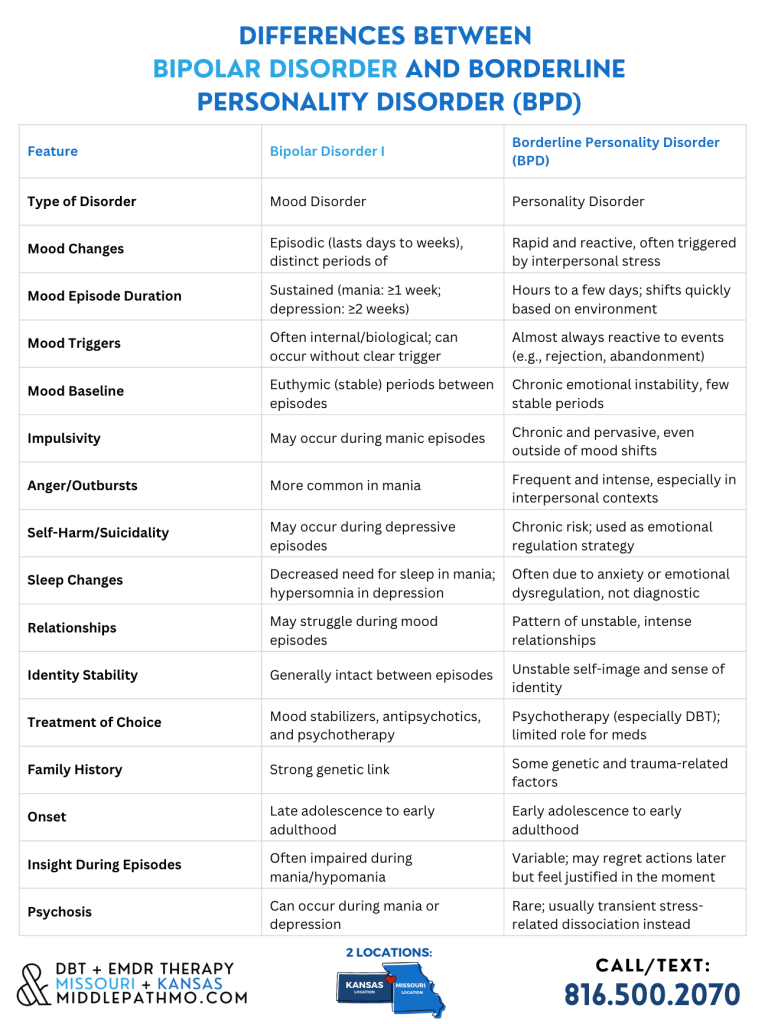
| Category | Borderline Personality Disorder | Bipolar Disorder |
|---|---|---|
| Type | Personality disorder | Mood disorder |
| Mood Changes | Fast, reactive (minutes to hours) | Slow, cyclical (days to weeks) |
| Triggers | Often interpersonal or environmental | Often occur without external triggers |
| Key Features | Fear of abandonment, unstable relationships, self-image issues | Periods of depression and mania/hypomania |
| Self-Harm or Suicidality | Common, often in response to emotional pain | May occur, often during depressive episodes |
| Treatment | Psychotherapy (DBT, EMDR), medication as needed | DBT, Mood stabilizers, psychotherapy, medication management |
Why It Matters
Misdiagnosis can delay effective treatment. Someone with BPD misdiagnosed with Bipolar Disorder might be prescribed mood stabilizers or antipsychotics without ever receiving the therapy that could change their life. Likewise, someone with Bipolar Disorder might struggle with medication compliance if they don’t understand the cyclical nature of their illness.
Good News: Both Are Treatable
- People with BPD benefit greatly from therapies like Dialectical Behavior Therapy (DBT) and EMDR.
- People with Bipolar Disorder often find relief with medication, lifestyle support, and DBT and supportive therapy.
- Many individuals live full, meaningful lives with the right support in place.
Final Thoughts
If you or someone you love struggles with intense emotions, unpredictable moods, or difficulty in relationships, it’s important to get an accurate diagnosis from a licensed mental health professional. The right name for what you’re experiencing can open the door to the right kind of healing.
You’re not alone — and help is out there.
Click below for the BiPolar Check-In.

 Middle Path Counseling MO