Middle Path Counseling : What You Need to Know
Welcome to Middle Path Counseling (MPC)! Whether you’re considering therapy for the first time or transitioning to our practice, we’re here to guide you through the process.
Meet Our Team
At MPC, we are proud to have a dedicated team of therapists and counseling interns who are committed to providing high-quality mental health care. Our licensed professionals specialize in Dialectical Behavior Therapy (DBT) and Eye Movement Desensitization and Reprocessing (EMDR) to support clients through various mental health challenges.
What We Treat
We offer therapy for a variety of mental health concerns, including:
✅ Depression & Anxiety
✅ Co-dependency Issues
✅ Grief & Loss
✅ Suicidal Thoughts / Self-Harm
✅ Boundary Development
✅ Toxic Relationships
✅ Personality & Mood Disorders
✅ Trauma
What We Do Not Treat
For ethical and clinical reasons, we do not offer services for:
❌ Eating Disorders
❌ Substance Abuse Treatment
❌ Play Therapy
❌ Children Under 14
❌ Sex Therapy
❌ Art Therapy
❌ Medication Management
Our Services
MPC provides a range of therapeutic services to meet diverse client needs:
✔ Individual Therapy
✔ Group Therapy (Skills & Process Groups)
✔ Marriage & Family Therapy
✔ Mental Health Evaluations
✔ Coaching Calls
All group therapy sessions are conducted virtually for accessibility and convenience.
Understanding DBT & EMDR
What is DBT?
Dialectical Behavior Therapy (DBT) is a structured form of therapy developed to help individuals regulate emotions, improve interpersonal relationships, and build coping skills. It consists of four key components:
- Mindfulness: Staying present in the moment
- Distress Tolerance: Managing overwhelming emotions
- Emotion Regulation: Understanding and validating emotions
- Interpersonal Effectiveness: Building healthy relationships and setting boundaries
What is EMDR?
Eye Movement Desensitization and Reprocessing (EMDR) is a trauma-focused therapy designed to help individuals process distressing memories. Through guided bilateral stimulation (eye movements, tapping, or auditory cues), EMDR helps reduce emotional distress tied to traumatic experiences. This approach has been widely used to treat PTSD, anxiety, depression, and trauma-related disorders.
Locations & Payment Options
We offer in-person sessions at two locations:
📍 Blue Springs, MO: 1942 NW Copper Oaks Circle
📍 Leawood, KS: 11100 Ash St. Suite 109
Additionally, virtual therapy sessions are always available.
Session Costs
💲 Self-Pay Rates:
- Initial Intake Session (60 min) – $150
- Individual Therapy Session (60 min) – $125
- Group Therapy Sessions – $40 each
We accept AETNA, BCBS, and most major insurance plans, though we do not participate in Employee Assistance Programs (EAPs). Clients are encouraged to verify insurance coverage, as deductibles often reset annually.
Additional Fees
⏳ Late Cancellation / No-Show:
- $75 (before 3 PM) | $100 (after 3 PM)
- $100 for Marriage & Family Therapy cancellations
📄 Legal & Documentation Fees:
- FMLA/Disability Paperwork: Requires 6 sessions of care; $100/hour
- Letters from Therapists: $100 per request (excluding school/work excuses)
- Client Records: Free via portal; printed copies are $100
Important Policies
✔ Informed Consent: Therapy at MPC follows structured DBT and EMDR modalities aimed at achieving treatment goals such as emotion regulation and trauma processing.
✔ Confidentiality: Therapy is confidential, but mandatory reporting laws require disclosures in cases of safety concerns, child/elder abuse, or court orders.
✔ Marriage & Family Therapy Policy: We operate under a “No Secrets” policy, meaning therapists will not withhold information that could impact relational work.
✔ Telehealth vs. In-Person: We offer both telehealth and in-person options, but we assess suitability on a case-by-case basis.
✔ Sober Participation: Clients must be sober during sessions. If impairment is suspected, the session will end, and a self-pay fee will be charged.
Resources & Contact Information
We provide a free DBT workbook, “Finding Middle Path,” available on our website: MiddlePathMO.com.
📞 Contact Us
- Phone: 816.500.2070
- Email: admin@middlepathmo.com
- Instagram: @middlepathmo
How Do I Get Started?
How long is a Therapy Session?
The best way to answer this is that a typical therapy session is 53 minutes. This is considered a Therapeutic Hour to account for documentation that needs to be done for the insurance company. Even for our clients who are Self Pay we still do a 53 minute sessions.
Where is my link for my Telehealth session?
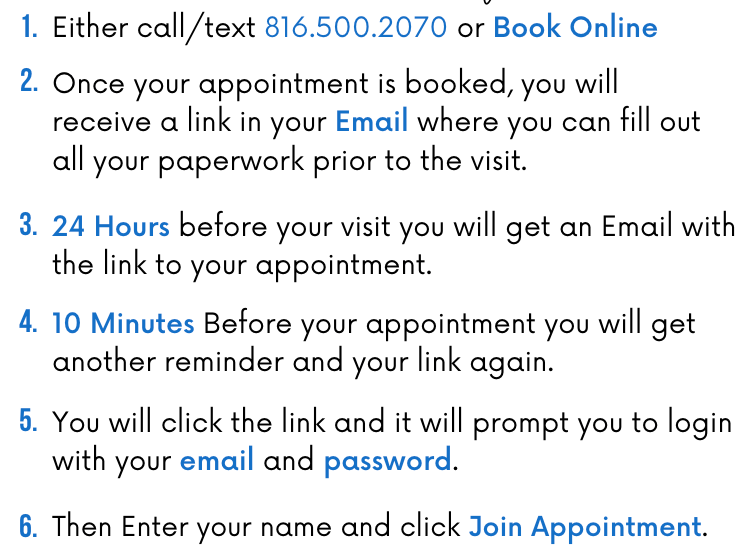
When you sign up for a therapy session you use your email so that you can get all your documents in your client portal. If you sign up for text and email communication it can come through both. You should get a reminder to your appointment 10-15 minutes before your appointment via text and email (depending on what you gave permission for). There it will have a link to click through and sign on with. If you do not have the link you can text us at 816.500.2070 and you can update your phone number and email in the client portal at anytime.
Do you accept my EAP?
At this time we do not work with any EAPs. EAP’s are Employe Assistance Programs that are a benefit of the company you work with and are not directly tied to your insurance. Therefore, we have no knowledge if your company offers this by running/pre-checking your insurance.
We suggest you talk to your HR director to find out how to best use this resource.
**Employee Assistance Program: An Employee Assistance Program (EAP) is a workplace benefit provided by some employers to help employees address personal problems that may affect their job performance and well-being. These programs typically offer confidential counseling and support services for issues such as stress, mental health, substance abuse, financial problems, and more.
Why do you come up in our EAP Search?
Because we are IN NETWORK with so many insurance companies it automatically populates.
What Insurance are you In Network with?
- AETNA
- Humana
- Medica
- United Healthcare
- UMR
- HealthSCOPE
- Cigna
- Optum
- Blue Cross and Blue Shield
I have insurance, why was my card charged?
With health insurance each plan is different. We do run Insurance and Benefits checks prior to each session. You are also encouraged to call the number on the card that is next to Behavioral Health.
When we check with insurance, there will either be a Co-Pay or a Deductible associated with the visit that can range from $0-150. This is based on your plan and the contracted amount that is associated with the insurance company and Middle Path Counseling.
At the time/day of service we run the card on file to what the contracted Co-Pay or Deductible is. We also submit a Claim to the Insurance company. If the insurance company comes back with a different amount then what was quoted, then we have to adhere to what the insurance company tells up. This means you may owe more then what was expected.
This is why it is important to contact your insurance company and double check what is covered.
Middle Path Counseling MO has a policy that we do not allow clients to carry a balance. If there is a balance for any reason, we will ask that amount to be paid before your next session.
*Your card can also be charged if you had a late cancel or no show fee.
What should I expect from my first appointment?
The first appointment is called an Intake/Initial Assessment. In the first session we ask you a lot of questions about your life so we can get a better understanding as to what is going on.
With Middle Path Counseling our Intake Process includes a few extra things to understand and treatment plan better:
- Intake/Initial Assessment
- Family Dynamic Questions
- Genogram
- Values Assessment
- DBT House/Goal Setting
Be sure to ask your therapist about these tools and make sure you are getting the maximum out of your therapy experience.
I have a Telehealth session, what should I know?
While we love doing Telehealth and you can typically do it anywhere. There are a few things to consider:
- You need to be in a Private Space due to HIPAA.
- You need to have headphone/earbuds so you can control who can hear.
- You can not be driving, on a boat, etc. Your safety is the most important and if that is not guaranteed then we can not continue the session.
- Your wifi needs to be strong and stable. Please be aware that if you use public wifi you can be at risk of other factors.
- You need to be fully dressed and approprate to meet with your counselor.
- Please reframe from smoking/vaping as a counselor can not verify what substance you are indulging in.
- You need to be coherent, awake and able to consent to care.
Standard Insurance Coding
For mental health and counseling services, you may want to look into codes related to psychotherapy. Common codes include:
- 90837: Psychotherapy, 60 minutes
- 90834: Psychotherapy, 45 minutes
- 90832: Psychotherapy, 30 minutes
- 90847: Family psychotherapy (with the patient present)
- 90791: Diagnostic evaluation
- 90853: Group psychotherapy
Keep in mind that these codes can be updated, and the specific codes accepted by insurance providers may vary. It’s crucial to verify with the specific insurance company you’re dealing with and stay informed about any changes in coding systems. You may also consider consulting with a billing specialist or contacting the insurance company directly for the most accurate and up-to-date information.
Where can I find the Orientation and Screening Slide Show?

 Middle Path Counseling MO